
Translating LinkedIn into many languages

Hi everyone. My name is Nico Posner, and I am the product manager responsible for our international sites here at LinkedIn.
LinkedIn is a global network of over 42 million professionals from every country around the world, with approximately half of our member base outside the United States. Our mission at LinkedIn is to connect the world’s professionals, and we would like to do this in as many languages as possible. A frequent request from our members is to offer the LinkedIn website in their native language. Today, the LinkedIn website is available in four languages: English, Spanish, French and German (we allow users to offer their profiles in over 40 languages), but we’d like to extend that to as many professionals as possible around the globe by offering additional languages.
Currently, we are investigating the best way to translate our site into more languages. Since this is a decision that will impact millions of our users, we wanted to hear from our members on what they thought were some of the most effective ways to make this happen. Fortunately, some of the best professional experts in this area are members of the LinkedIn community, so we were able to leverage their insights through a direct survey. The chart below outlines the responses we got from over 12,000 professionals this past week.
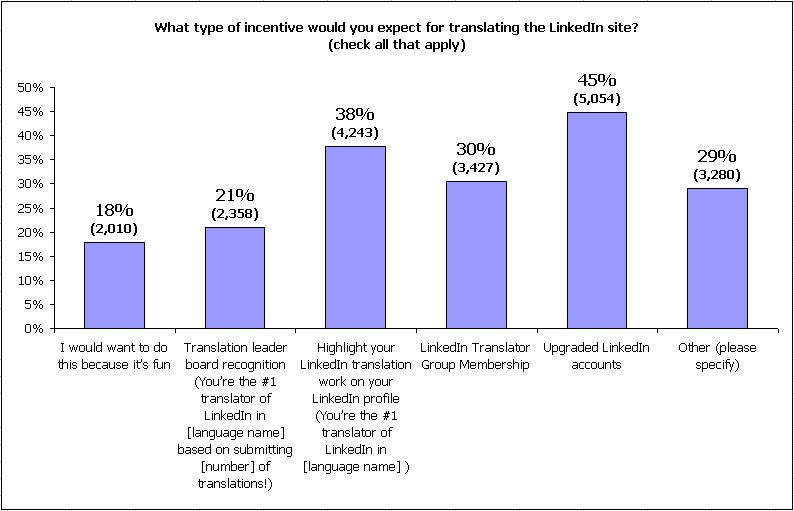
We are happy to see that thousands of members expressed an interest in contributing to the translation of LinkedIn. More importantly, this survey gives us a deeper understanding of what would be of value to the members who expressed interest in bringing LinkedIn into additional languages. These options typify some of the value propositions that members often get from LinkedIn, and we were interested in hearing which ones would be of most interest. You can see the range of responses above. Premium subscription was the most popular choice, followed by recognition on a member’s profile. Requests for direct compensation was the most common response under the “Other” category.
Our survey shows that one of the most important benefits of a community translation effort on LinkedIn would be that a member’s contributions could be highlighted directly on their professional profile. Numerous professionals demonstrate their expertise on LinkedIn every day as a means of enhancing their professional reputation. This effort could extend those benefits to members who work in the translation and localization industry.
We are still in the process of evaluating different options for translating the site into additional languages. Thank you to all of the members who’ve taken time to offer us your valuable feedback.
Tags: linkedin-international, linkedin-languages, linkedin-localization, linkedin-translation, nico-posner
trackback
http://blog.linkedin.com/2009/06/19/nico-posner-translating-linkedin-into-many-languages/trackback/


Nataly Kelly June 19th, 2009
I would like to shed some additional light on the information Nico shared.
With this announcement, LinkedIn is joining the ranks of other companies that have recognized the benefits of harnessing expertise – and in this case, translation skills – among the members of multilingual and global online communities.
Common Sense Advisory has been writing about the practice of community, crowdsourced, and collaborative translation (collectively referred to as “CT3″) since their inception. Our research shows that many leading companies are spearheading CT3 initiatives (“Translation for, of, and by the People,” Dec08).
There are many advantages of CT3 practices, and quality improvement is one important consideration for organizations embarking upon these endeavors. To quote from our inaugural report on community translation, in which we discuss the differences between this emerging model and the standard process, “The metaphor for traditional translation is a chain. It is only as strong as its weakest link. The longer the chain, the more weak links you will find. Think about a rope. It draws its strength from its many strands. The failure of an individual fiber would not cause critical failure” (“Collaborative Translation,” Dec07).
In other words, while CT3 breaks away from the status quo in the translation field, it offers many benefits. Our research reveals that the companies engaging in this practice do so for three primary reasons: speed (faster time to market), quality improvement (end-user involvement boosts quality), and reach (a collaborative approach extends global reach through word-of-mouth marketing and community-building).
We look forward to following the progress of the new CT3 initiatives at LinkedIn. More information on CT3 efforts can be obtained via our website, http://www.commonsenseadvisory.com, and our industry blog, http://www.globalwatchtower.com.
Andriy Podanenko June 20th, 2009
Glad to see such movements into translation progress
The best way with collaborate translations is gettext based translation system (such as http://drupal.org )
Everyone who wants to participate just downloads *.po file and make off-line or on-line translations.
Waiting for the possibility to translate LinkedIn into Ukrainian 8)
Rudolf June 20th, 2009
Hi Nico,
Thanks for your update on Linkedin’s internationalization/translation efforts.
I am not so sure I would be happy if Linkedin would be transformed from a truly global network into a collection of many separate networks, all in their own native languages. Fact is that probably millions of members not belonging to the Anglosphere have compiled their profiles in English instead of in their native languages. Huge advantage is that all these profiles can be interpreted by the “global community”, which will be lost if Linkedin becomes a collection of many localized networks in languages which others cannot read.
Instead, I would welcome a further development of Linkedin where members get the opportunity to have bilingual or multilingual profiles, all as a “single member of the Linkedin network”. Of course there is nothing wrong with having the option of a localized profile template.
Regards,
Rudolf
Matthew Bennett June 20th, 2009
Hi Nico, interesting to see the results of your survey after this week’s clash and discussion with professional translators.
Was the survey sent to 12,000 translators or was it sent to 12,000 users who work across all sectors?
Riccardo Mori June 20th, 2009
If anyone is interested in what some professional translators here on LinkedIn think about the whole matter, they can follow the discussions here: http://bit.ly/OFSwv
Especially the “Featured discussion”. Mind you, I’m not trying to start any flame or anything, I just think that the public should know what some of the professional translators who participated in the survey think about the initiative and how they’ve been approached.
Thanks and kind regards,
Rick
Nico Posner June 20th, 2009
Thanks everyone for your comments on this topic.
@Rudolf: LinkedIn’s mission is to make the world’s professionals more successful, including professionals who do not speak English.
Enabling members to increase the power of their LinkedIn network by connecting English speaking professionals as well as non-English speaking professionals to their networks, irrespective of their preferred or spoken language is consistent with that mission.
Many members from non-English speaking countries have created profiles in English, and others have used LinkedIn’s multi-language profile functionality that enables members to create multiple versions of their profile in different languages, all tied to their single LinkedIn account (details here: http://blog.linkedin.com/2008/11/19/now-your-linkedin-profile-speaks-espanol-francais-41-more-languages/ ).
@Matthew: Of the 12,000 responses, over half (50.5%) were from non-translators and the rest (49.5%) were translators (either now or sometime in the past). Overall, the results were largely the same, although professional translators were more interested in gaining a credential on their profiles than non-translators.
Regards,
Nico
Marty Mallavibarrena June 21st, 2009
Hi Nico. Good to hear about translation in LinkedIN.
In Spain we’re lucky because you’re translating main parts of the Site (but not all of them, at the moment).
I think is a good idea to add the translation effort from local users the support from local companies adding local info (ads in spanish are starting now, right?) about events and other interesting data.
The Blog could have posts in several languajes so spanish users can be more excited reading it!
In all of these activities I can cooperate. Don’t hesitate if you think I can be of assitance.
Thanks for LinkedIn and Regards (from Spain)
Marty Mallavibarrena
vinod June 21st, 2009
It is going to be a great start because lots of other people can also become LinkedIn member.
All the best.
Grey Drane June 22nd, 2009
Personally, I find LinkedIn’s overall approach to this project to be increasingly offensive:
First, because of how their survey apparently targeted language professionals and then didn’t even put “direct compensation” on the list of possible responses. I’d be curious to see how the results would have been different if that had been one of the main choices and not something you had to write in as “Other”.
Now, the way LinkedIn is just trying to ignore this controversy is doubly offensive. First, the blog post above is all happy and rosy and very quickly glosses over the payment issue. Then Rick mentions the controversy here in a perfectly polite manner, but Posner comes back and responds to comments just before Rick’s and apparently ignores the controversy again. Posner did contribute once early on (and in a largely unsatisfactory manner) to the group Rick has linked to, but has since done absolutely nothing to address the very valid concerns, criticisms, and suggestions that have been raised there since.
Rick said he doesn’t want to start a flame war, and that’s certainly not my intention here either, but SOMETHING needs to be said to address the issue.
Disappointed,
Grey
Rudolf June 22nd, 2009
Hi Nico,
Thank you for your reply. And for the info !!!
Seems that I missed Linkedin’s announcement of last November completely. My fault.
I haven’t tried it yet, but it seems to be precisely what I meant with my comment.
Thanks,
Rudolf Kriens
Nico Posner June 22nd, 2009
Grey,
We apologize for any offense taken – none was intended. We’re actually spending quite a bit of time on this issue, and feel that the post above does clearly articulate our goals and methodology for the survey, as well as some of the results. No survey answers every possible question along every possible dimension, but each is part of the overall learning process.
We were using the survey in part to specifically look at other possible forms of reward for contributions, which is why we did not focus on compensation. Please remember that we have already done 3 major translations in the past year (Spanish, French, German) through a traditional translation process, so we already have direct experience with compensation issues and requirements. We have leveraged professional translators, with compensation, for all of our translations to date, and we will continue to leverage professional translators going forward.
Regards,
Nico
Grey Drane June 22nd, 2009
And now you would like to leverage professional translators without compensation? Good luck with that.
In any event, thanks for the apology, although I’m not sure why it’s taken nearly a week for it to happen, and I would really have preferred seeing a more general apology to all of the professional translators you have offended and/or otherwise upset with your approach to this project.
It also seems to me that you could have gotten much better response if you had been more up front with us from the beginning, rather than using such a blunt instrument as that brief survey was.
You know from our profiles that we’re professionals in the field, so why not ask us some more detailed questions and take advantage of our knowledge and experience — and show us some respect — rather than just asking us what it would take for us to do the work for free?
Regards,
Grey
Tom Hundt June 24th, 2009
I laughed, too, when I saw the chart and didn’t see “Get paid” as one of the answers. That’s fine, perhaps you’ll hire professional translators to get it done, maybe not. This isn’t Wikipedia, so, maybe you’ll actually try and maintain your “professional” image, and pay people. Problem is, translating the boilerplate text is the EASY part.
The HARD part is figuring out how to keep the site integrated and useful, instead of fragmenting into a German site, a Ukranian site, etc. For example, I don’t see any way to tag content in my profile as being in any particular language, nor do I see a way to indicate what languages I can read. Guess what: I speak German. Am I really expected to go and type in “linkedin.de” to make use of that? If you ask me, THIS is what you should be asking for input on, not the mechanics of how to get a site’s text translated.
Should LinkedIn Users Work for Linked for Free? « LinkedIn Expert Advice & Insight through Your Questions – A LinkedIn Blog that Goes Beyond the "Official" Explanations June 24th, 2009
[...] take a closer look at the translator issue. LinkedIn released a blog post recently that informed the world that they are trying to make their platform more localized for [...]
LinkedIn Users Would Translate for Upgraded Accounts | Blog Free Now June 24th, 2009
[...] we are investigating the best way to translate our site into more languages," says LinkedIn’s Nico Posner. "Since this is a decision that will impact millions of our [...]
Lew Peterman June 25th, 2009
Using the link emailed to me, I am not being redirected to the discussion as would be proper. Instead I go to the login and am then sent to “my home page” and can not get to the discussion no matter how hard I try.
The only way to get to it is to copy the link and then after I get to the home page, I cut/paste the link to get to the discussion.
Jiri Stejskal June 26th, 2009
There is a difference between helping a charitable organization and providing a free service to a for-profit business like LinkedIn. Since I assume you employ professional programmers, marketers, accountants, legal advisers and copywriters, and pay them professional rates, your appeal for “translation volunteers” is incongruous to say the least.
Companies seeking global reach regularly lose face and money by relying on non-professionals to translate key materials. The embarrassing results are generally set right by professional translators.
Jiri Stejskal
President of the American Translators Association
Ellis Jongsma June 29th, 2009
Indeed, it would have been nice to have an option in the survey to choose for a ‘paid’ job. Would LinkedIn have done the same if they wanted to redesign the website? “We need a new design, how about a free account?” I don’t think so.
Xing To Give Up China And Make Way For LinkedIn In The US? June 29th, 2009
[...] is currently available in four languages (English, Spanish, French and German), with more to come soon. The only office outside the US is located in London. In Europe, LinkedIn is particularly strong in [...]
Martin-Éric June 29th, 2009
I really don’t need the ability to use LinkedIN in languages other than English and I would only have marginal uses for the ability to write my profile in languages other than English.
Instead, what I’d really like LinkedIN to do is to get around adding a section in people’s profiles where they can list the languages they master, because multilingual abilities truly make a difference in the professional markets outside USA. Besides, this is a standard feature on competing business networking sites, so there’s really no excuse not to provide it.
On another issue, I’d really like LinkedIN to offer European Union as a country of residence. Right now, the current way of restricting people to a single country is about as stupid as forcing US residents to restrict themselves to a single one of the 50 states would be, instead of allowing them to cover the whole USA. EU is a country just as USA is, so please add it to the list.
Martin-Éric
Xing To Give Up China And Make Way For LinkedIn In The US? | eMediaOne June 29th, 2009
[...] is currently available in four languages (English, Spanish, French and German), with more to come soon. The only office outside the US is located in <a [...]
Nico Posner June 29th, 2009
@Jiri:
As I mentioned in my earlier comment above, all of our prior translations were done with the efforts of professional translators and were compensated for. And, we will continue leveraging professional translators moving forward as well.
I’d like to reiterate that the survey was a means to gauge interest from our users with regard to translating the site. Feedback is incredibly important to us, which is why we survey our users to evaluate different options.
@Martin-Eric:
We’ll be adding the ability to specify spoken languages within your profiles soon. Stay tuned.
Nico
Lois Feuerle July 1st, 2009
I would like to join in Jiri Stejsal’s comment that translation services should be compensated in the same way as the work performed by accountants, attorneys, secretaries, administrative assistants, etc.
Gillian July 1st, 2009
I’m multilingual with a native language of UK English but really agree that losing the common-language element of LinkedIn would be hard. Many people contribute in ‘their best’ English and the site is all the richer for that because it easy to make links across the globe. If we all disappear into our own language silos we gain nothing. Personally, I’d be quite happy in a number of other languages but that’s not everyone. I’d suggest keeping ‘English’ (in all its multitude of variants) as the core and having optional non-English areas. it’s all in the market emphasis…
Rudolf July 2nd, 2009
@Nico,
What I really wonder is what the impact is on SERP’s if one has multiple language profiles, i.e. a main profile (in English ?) and alternative profiles in one or more other languages (e.g. German, Spanish, …).
With SERP’s I imply both the search results as might be obtained on the wider web (Google, Yahoo, Bing search) and the search results obtained within the Linkedin environment itself.
I would appreciate if you could elaborate on this and how we should take such impacts into account in case we would opt for having a multilingual profile.
Regards
Wąsaty tłumacz » LinkedIn kontra tłumacze July 6th, 2009
[...] http://blog.linkedin.com/2009/06/19/nico-posner-translating-linkedin-into-many-languages/ [...]
Claire-Juliette Beale July 6th, 2009
Completely concur with Rudolf and other comments above on several points. I assume this is part of an international expansion strategy to secure future growth, and building various language versions may be weighted against or added to other options such as acquiring and enabling national or regional players.
1. LinkedIn sites in other languages
I have doubts that folks who’ve already signed up to national alternatives (and there are many in France for instance) will switch to LinkedIn as active users, unless they happen to have global/international business interest in which case they’re ready to sign to LinkedIn in English anyway. If they’re not active on LinkedIn then I’m better off networking with them where they are.
For new users (those who are not on any networking tool), chances are they’ll become active where most of their peers are and preferences tend to go to region/country centric solutions.
My interest would be the ability to show my existing profile in a foreign language if it will help for SEO / online promotion purposes in that language. However I suspect (correct if wrong) French folks doing searches from French search engines or French version of Google are more likely to find my profile in Viadeo, Copains d’Avant, and the like first, at least until LinkedIn France is well established.
In addition, though I have the capability (trained in translation) I don’t have the time to translate my page. It would be surprising I’m the only one. Maybe there’s an opportunity for LinkedIn to offer translation options, or partner with professional/student translators to offer the service.
2. Translation.
Quality is critical. There’s nothing like launching a website with shoddy translation to ruin your effort. At minimum each language version must be proofed / edited by an excellent professional of the target language before launch. If translations are previously handled by amateurs or by translators who are not of the target language it’s likely there will be lots of edits to be made.
Time. If time is money, given the time involved in the management of an open process I’m not sure at all it will be worth, particularly if there’s no translator quality/experience screening process.
I was involved in the design and the global launch of Global Market Insite (GMI), a company with both B2B and B2C websites. The B2C website GlobalTestMarket.com was available in more than 30 languages. Whenever possible we used members of our core staff who were bilingual and/or a network of cost effective professional translators that we administered. New version were always proofread by native readers.
Nico Posner July 7th, 2009
@Gillian,
To better serve the needs of the majority of our users who may not be multi-lingual (as you are), we do plan on expanding the breadth of languages of the LinkedIn site.
@Rudolf,
Currently our site does allow for multiple profile languages. For e.g., I have an English and a German language profile. Members can always toggle between the two by clicking on the link near the top right that says “Profile: [English]” or “Profile: [German]“.
My recommendation would be to create as many language profiles as your language proficiency allows for, and rest assured, we¹ll present the most useful one by default to users searching on LinkedIn as well as on different search engines.
@Claire-Juliette,
I agree that quality is critical. This is why we are evaluating various options to ensure that LinkedIn offered in additional languages will be of sufficient quality and allow for a great user experience.
Thanks to everyone on this thread for your continued feedback. Much appreciated.
Nico
João Paulo July 16th, 2009
+1 to the ability to specify spoken languages within profiles. Right now that’s the only reason I have to still have a separate CV. Absolutely necessary!
Greg's Seo Copywriting Services August 12th, 2009
While it would be nice to make English the worldwide language, it keeps LinkedIn from truly “going global.” However, to truly be global as a business person requires some knowledge of English. Let’s face it, English is the language of business today.
Facebook Files For Patent On Crowdsourced Translations August 26th, 2009
[...] free crowdsourced translation hasn’t always been positive — LinkedIn recently conducted a survey to gauge what kind of incentive its users wanted to help it translate the professional networking [...]
Ruth Souza September 19th, 2009
Translating LinkedIn to other languages is an awesome idea. I have family in Brazil that is ready to join. I have answered questions in Spanish and Portuguese (Brazilian) and have contacts that use these languages to communicate. Being able to relate to people who speak languages other than English is a way to practice that language and for many in the US might be a way to stay connected to their native land and language.
Ruth Souza
Christopher Korah September 22nd, 2009
I’m curious to know when LinkedIn will launch the ability to create Company Profiles in multiple languages, similar to how we can with our individual CVs.
Living in Quebec, a bilingual province, and consequently operating as a bilingual institution, I would not want to offend one of the language groups in our audience simply because there isn’t enough room to create a bilingual profile in the given template. Any news from the LinkedIn management would be appreciated.
Dirk Frey September 29th, 2009
@Christopher- Thanks for the suggestion. I’ve forwarded your request onto the group assigned to Company Profiles.
David Russi October 12th, 2009
Just curious: Is LinkedIn planning to crowdsource legal services, IT services, graphic design services and the like, or is translation the only industry that can be singled out for this treatment?
Burak Yalcin October 19th, 2009
What about Turkish language?
Turkey, located at the intersection point of the European and Asian continents with its strategic location that allows transit to the former Soviet Republics and other countries of Asia, is a large country with a population of 71 million and a promising future. The Turkish economy is one of the fastest developing economies amongst OECD countries, with an average growth rate of 7%, which is well above many member countries. The cumulative foreign investment in Turkey is around US$111 billion, and the number of foreign companies operating in Turkey is in excess of 18000, including many of the global Fortune 500.
With respect to Turkey’s population and potential, I think Turkish language needs to be reconsidered for LinkedIn user interface.
Kind regards,
“by”
Mario Sundar October 20th, 2009
@Burak,
Thanks for the feedback. I’ve passed it onto our International Localization teams.
Much appreciated. Mario from LinkedIn
Dirk Frey October 22nd, 2009
@Burak- Thanks for your feedback. We continue to investigate other Language prospects that would best fit the needs of existing members as well as grow our member base. I’ve forwarded your comments on to the International team for review. Thanks for your comments. -Dirk