
Home > Full Story

Whether or not we realize it, we all live and work in a networked world.  Reputations matter.  Relationships matter.  Information is bombarding us from a rapidly swelling variety of sources, with increasing frequency and variability in terms of quality.  Interestingly, people are managing this incredible increase in complexity with habits and business practices that date back decades, if not centuries.

They consider the source.  They consider the context.

Fortunately, in the 21st century, with the birth of the social web, we have tools at our disposal that are orders of magnitude more powerful than we have ever had as individuals or as a society.  To quote David Weinberger from his recent talk at PDF09, Transparency is the New Objectivity:

What we used to believe because we thought the author was objective we now believe because we can see through the author’s writings to the sources and values that brought her to that position. Transparency gives the reader information by which she can undo some of the unintended effects of the ever-present biases. Transparency brings us to reliability the way objectivity used to.

This change is, well, epochal.

David is talking about journalism, but his insights are at the heart of why LinkedIn is such a powerful concept.  On LinkedIn, the skills that you’ve spent your career obtaining, the experience that you’ve earned, the trusted relationships that you’ve formed – they are all made largely transparent.  Your professional reputation and relationships matter – and not just to you.  That value extends far beyond your profile itself – it carries over to every interaction, every message, and every piece of contributed content.

LinkedIn Recommendations are a great example.

Most people who have applied to higher level educational institutions are familiar with the traditional methods of gathering recommendations.  Finding an advisor, mentor, or teacher willing to fill out a series of questions and write a sealed letter of recommendation.

LinkedIn Recommendations bring liquidity and transparency to the reputation economy.  As a result, the way people evaluate and respond to recommendations is changing as well.

Jeremiah Owyang wrote a post recently about a decision he has made to temporarily stop giving recommendations on LinkedIn.  In his post, he flags a number of concerns he has heard about recommendations and their relative value.  The comments on his post, and the responses on Twitter were interesting enough that it seems worthwhile to capture five of the insights about LinkedIn recommendations I gleaned here:

  1. Reputation matters. On LinkedIn, your profile and reputation is tied to every recommendation you make.  As  a result, people can and do consider the source.  Having someone say you are a Web 2.0 visionary is fine and dandy, but those exact words coming from Jeremiah Owyang means something different.
  2. Transparency matters. It’s trivial to see how many recommendations a person has given, and whether they tend to write the same things about everyone.  It’s also fairly trivial to see the relationship between the person being recommended and the source.
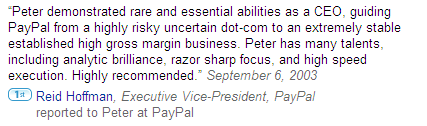
  3. Content matters. Which recommendations a person publishes is up to the individual.  As a result, you won’t find “negative recommendations” (isn’t that an oxymoron?) on the site, any more that you would expect a person giving references for a job to give you people who think poorly of them.  However, recommendations speak volumes in terms of what they do and don’t say. Check out this recommendation for Peter Thiel from Reid Hoffman:
  4. Recommendation

    Detailed characteristics, specific achievements, highly credible and relevant source.  That’s what you want to see.

  5. Recommendations are often mutual. Is this really a surprise?  Most productive, informed positive professional relationships are mutual.  As a result, most people will, in fact, leave recommendations for each other.  The fact that you’re own reputation is tied to any recommendation you write is an incredibly significant incentive to keep words honest and defensible.
  6. Requesting recommendations is normal. Think about this for a second.  Who are the people you most value professionally?  Do they know it?  More importantly, do others know?  In a perfect world, we would all proactively make sure that the people who have earned our trust and respect knew it, and that others knew it as well.  But we’re all busy, and the task rarely feels urgent.  That’s why, for literally centuries, most recommendations have been requested rather than spontaneously given.
As food for thought, let me challenge you to consider the following:

In this economy, more than ever people are realizing that the most important assets they have are the skills and experiences they have earned, and the trusted relationships they have formed.  As I mentioned above, we all know great people who deserve our public recognition.  They deserve the benefit of our hard-earned reputations, applied to endorse theirs.

So I ask each of you to take the time to select three of your connections who fit this description, and write them a LinkedIn recommendation, unsolicited.

My guess is that not only will the experience be rewarding for them, but it will also significantly rewarding for you.

Trackback: http://blog.linkedin.com/2009/07/23/adam-nash-recommendations-and-the-reputation-economy/trackback/
Add New Comment

Comments

  • Trace Mayer July 24th, 2009

    Good post. Reminds me of a presentation at WordCamp 2009 in SF about The Whuffie Factor (a book the presenter was promoting). In essence, we all have a certain amount of ‘whuffie’ which is the digital currency in social networks and represents our ability to influence others. We gain whuffie from the articles we write, videos we make, speeches we give, etc.

    LinkedIn recommendations are a great way to ‘transfer whuffie’ to those we feel deserve it and we all know the old saying, ‘What goes around comes around.’ I need to think about the three people to transfer some whuffie to.

     
  • Simple July 24th, 2009

    yah definitely, linkedin is the source of information for professionals like us.. Thx linkedin team

     
  • Jeff Mole July 24th, 2009

    I have in excess of 50 recommendations. Being highly recommended is important to me. It is one of the reasons that I give a little extra. Please feel free to invite me.
    Jeff Mole
    Recruiting Professional
    Toronto, Canada

     
  • Donna Brewington White July 24th, 2009

    This is an excellent post and an excellent suggestion. I have never taken LinkedIn recommmendations very seriously. As a recruiter, I recognize their limitations. However, you have given me much food for thought…and challenged me not to throw out the baby with the bathwater…so to speak. Thank you.

     
  • marketing veep July 26th, 2009

    Very useful and constructive post. Thanks!

     
  • Heidi Mankoff July 30th, 2009

    Fantastic article. In many cases, we struggle with self-promotion. The core challenge is “how much confidence is too much confidence?” Testimonials relieve the pressure for us…when someone else writes about our skills and abilities, we maintain our modesty and feel better about sharing the content. As any good PR expert knows, there is so much value in SOMEONE ELSE sharing and promoting your services.

    However, as powerful as testimonials can be, using them for self-promotion must be intentional. You must be able to link the testimonial to the exact skill (or set of skills) you want to highlight, and place them where it is most relevant for your prospects to see them.

    On a daily basis, small business owners tell me that their best source for new business prospects is their current base of customers. What’s surprising, is that very few of them are actually soliciting testimonials and using them as part of their promotional efforts!

     
  • Roque Cruz July 31st, 2009

    Dear Adam,
    LinkedIn has a great penetration in Brazil,
    why not have a version in Portuguese?
    Regards!
    Roque

     
  • Jacob Cynamon August 6th, 2009

    Adam et al,

    I came fairly early to LinkedIn and have found it invaluable as a vehicle to publicly display my experience (Profile) and share my expertise (LinkedIn Answers). I have had three main jobs in the last several years and found the ability to capture and maintain recommendations is invaluable. Former colleagues and managers can be hard to track down or forget the immediate impact you might have provided through your work – requesting a recommendation when the memory is fresh can go a long way to capturing the true essence of what you invested through your work.

    One of my former managers was a big fan of “Whale Done” and “The One-Minute Manager” – books designed to remind managers that positive feedback goes a long way. LinkedIn has made recommendations the new currency of positive feedback – an almost tangible resource that you can possess long after you have finished the project or changed teams or organizations.

    What I think would make a valuable addition to the recommendation ‘engine’ is increased visibility into the relationships of the recommended and recommending parties. Currently, LinkedIn is a system that has very little differentiation between relationship “weights”

    1) Not connected
    2) Connected indirectly (1+ degrees away)
    3) Connected directly
    4) Recommended

    Particularly at level 3, it can be difficult to ascertain how strong the bond is between two LinkedIn users. By determining a valuation system for these bonds, a third-party could better understand how to approach an individual for business opportunities or assess the merit of a candidate for a position. I’m not sure how much room I have in this comment field, so I’ll leave it at that for now, but I would be happy to explore this further.

     
  • Dinesh Ramakrishnan August 7th, 2009

    Adam, while I agree with your advice and that of several others in soliciting recommendations or providing them unsolicited, people outside the extended networks are currently unable to view them. Jacob posed the requirement to be able to distinguish between the relationship weights. It would be nice to view not only recommendations, but also be able to gauge the nature of the relationships between all three parties involved. I would, for one, certainly place more emphasis on the the contacts of someone that I trusted (or recommended), and thereby place more weightage on their recommendations.

     
  • Lubna August 8th, 2009

    Hi
    This is a very interesting post. Lately however, I and several of my first degree LinkedIn connections are disgruntled with how some people solicit recommendations at every opportunity under a reciprocal arrangement.
    There are so many instances, I will illustrate just two:
    1) Mr. A, sends Mr. Z a recommendation. They have interacted only on LinkedIn and are first degree connections. In turn, he asks for a specific recommendation relating to the work he does for his own consultancy (disguised as a non profit).
    2) Mr. A (the same Mr. A, incidentally), knows that Ms B is job hunting – she has put this message as her status message. He tells her to send her resume and asks for a recommedation. Nothing comes out of sending the resume. He does the same with Ms. C and so on.

    This is all quite sickening. I do think it is the quality of the recommendation and who has given it that counts, rather than the numbers. Unfortunately some people appear to be on a recommendation collection spree. I wonder whether there is anything that LinkedIn can do to stop this racket! I guess not. We live in a free society.

    That said, being a member of LinkedIn is a joyous experience.

    Best regards,
    Lubna

     
    • Dirk Frey August 14th, 2009

      @Lubna- Thanks for sharing your feedback on this. It’s up to you and I to hold true to our standards and recommend only those we truly value. A member of the LinkedIn network needs to understand that recommendations are about quality not quantity. Also writers of those recommendations should only write recommendations for those whose work they’ve experienced and value. It’s ultimately a reflection on the writer of the recommendation as well. I’ve forwarded your comments on for for the Recommendations Product manager can review as well.

       
  • Kenneth Wallin August 9th, 2009

    A super article about an issue with many supporters and just as many detractors. The supporters argue the recommendations show a person through the eyes of another as the resume/profile with the owner’s positive spin is already published. The recommendation adds background to the evaluation. The detractors basically believe they are false praise.

    I am solidly in the ranks of the supporters. There is a system in place, you can work within it, or stand outside and throw rocks. It will continue regardless.

    Now, with so many employers and recruiters searching for candidates from Linked In it is imperative one have a differentiator to rank one on the first page of the search. If not, one cotinues to stand outside and throw rocks claiming unfair. One could get busy and work the system presented. The playing field is level, some folks just want to remain elite and not get into the trenches.

     
  • David H. Deans August 10th, 2009

    Perhaps the best professional testimonials are the ones that also include a link to an example of the individual’s thought leadership content — something that demonstrates the skill or accomplishment being referenced.

    I work in the Technology, Media and Telecom sector, and I’m personally more impressed by substantive content than any other form of validation that the stated expertise is in fact apparent.

     
  • Gareth James August 11th, 2009

    This is a great idea which I have implimented. Escpecially when you know some of your connections are very good at what they do. Give and you will be given.

     
  • Lubna August 14th, 2009

    Thanks Dirk Frey.

     
  • Iftikhar Md Zia August 14th, 2009

    Hi

    Very nice post. I agree with most of the points.
    In fact many have started posting this as a question – why someone would need so many recommendations ?

    I have replied to some of the questions -
    I personally value recommendations from people with whom / for whom I have worked, and who can also vouch for me if somebody does contact them to verify with them.
    I consider this site as a professional site, and hence have not taken any recommendations from my school / college buddies who are also connected with me here, and can give me some fantastic recommendations – in the style I ask them to. And neither am I taking any recommendations from other friends or family who are well placed, but are no way connected with the work I do.

    And in any case – the person who is going to read the recommendation on my profile, would definitely look into who is the person who has recommended me or / and how I was involved with that person professionally. And anyway – only the top 4 or 5 would be read, and the balance few thousand…………?

    Lubna here illustrates an example – something which I can endorse. I am one of those who got mails from my contacts here requesting for a barter of recommendations. When I received the first one, I thought it was a joke.
    What do I recommend that person for, and how is he going to recommend me. I know xyz, and he is a nice person, or, I know xyz, and his answers are great ?
    But then I realized that this a practice of many here to ask for one and give one in return. Maybe a new member in LI would get impressed when he sees me with 4000 recommendations, but over a period of few days he is going to understand how this works.
    This would do more damage to me.

    If I meet more of my buyers / clients or my ex-MD here, I would not mind shamelessly asking them to give me a recommendation. And I am still willing to provide references or recommendations from them or others – if some one contacts me for business or jobs.

    I am happily connected with a few members, have built a good relationship with some of them, and I value the network here. If I do a business or get a job through a contact on LI – I will definitely add that member’s recommendation on my profile and will also give them one in return.

    It is something which I practice, and am not saying that this is the best one, as each and everyone has their style of doing things.

    Regards
    Zia

     
  • Nigel Roy August 19th, 2009

    Where is the setting to make recommendations public? On my public profile, http://www.linkedin.com/in/nigelroy – it is possible to see how many people recommended me, but I can’t see where to make the recommendations public? This is needless to say when looking for new roles, etc. that any one can read the recommendations.

    Thanks – Nigel Roy
    http://www.linkedin.com/in/nigelroy

     
    • Dirk Frey August 26th, 2009

      @Nigel- Recommendations are only visible to your network of 1st, 2nd, 3rd degree and group connections. I have forwarded on your comment, however for the Product Manager to consider as an enhancement. -Dirk

       
  • Harri Kilpiö November 4th, 2009

    I agree with @Nigel that the recommendations should be visible on the public profile.

     
  • Derek Donnelly December 8th, 2009

    I agree, an option to make all or specific recommendations visible on your public profile and to users outside your network would add a great deal of value to LinkedIn. Find it hard to understand the thinking behind restricting this feature. Surely people wish to promote themselves outside their 1st, 2nd, 3rd degree and group connections?

     
  • Rowena Simpson December 8th, 2009

    Linked In recommendations can be great for for your credibility, but beware of the pitfalls. Read my recent blog posting for my top tips with a Shakespearean slant!

    http://blog.giraffejobs.co.uk/shakespeare-does-linked-in/

     
  • Suzanne Bowen January 6th, 2010

    You said exactly what I was thinking but in different words. Linkedin and other great social media sites just give us more power than ever before to influence, so we need to use them well. The Linkedin recommendations are one of my favorite “tools” to use sincerely and truthfully. I recently blogged on this and backlinked to this article at http://suzanne.supertec.com/2010/01/victor-and-i-show-power-of-linkedin.html

     
  • Elias January 7th, 2010

    Excellent post, thank you for taking the time to write it so thoroughly.

    I have a question on LinkedIn etiquette regarding multiple requests for recommendations. As several friends face the risk of downsizing or have been downsized, they are asking for second recommendations after I have already written one. Does anyone do multiple recommendations for anyone?

    I think one excellent recommendation is best. I can appreciate my friends wanting to have fresh references for their job search, yet having two from the same person might undermine their value. What are your thoughts? Thank you!

     
  • Rajesh February 3rd, 2010

    hi how to edit or remove a recommendation given to a friend? is it possible to remove the one who wrote the recommendation?

     
    • Derek Homann February 4th, 2010

      @Rajesh- You can definitely take action on recommendations that you have provided for your connections. We actually have a link to an FAQ that should walk you through it. Check it out here:

      http://bit.ly/9EjHmk

      Also, for future reference, many of your questions may already be address in our Customer Service center, so please feel free to click on the ‘Help’ link int he top right hand corner of your page to help you find answers to any other questions you may have. Thanks.

      -Derek

       
  • lucythorpe March 1st, 2010

    I am new to Linkein and so far know only one person. The people I know from my old job who would give me a good recommendation are not on the site nor are peopel I have freelanced for since . How do I go about getting the recommendations I need? Can I bring a recommendation in from outside the system?

     
    • linkedin March 1st, 2010

      @Lucy,

      You can receive a recommendation from any of your connections.

       
  • Neal Linkon March 5th, 2010

    If you archive a recommendation, does that count towards completing your profile? My company doesn’t yet allow recommendations to appear, so we’re trying to decide if we should instruct staff to immediately archive them, or accept and then hide them. Any suggestions would be appreciated!

     
  • Robin May 21st, 2010

    I woud also like the option to make my recommendations pubic. This section is one of the great strengths of Linkedin, where 3rd party input to your personal marketing statements adds credibility. It would be great to be able to leverage this to the full extent by making these public. Additionally, as recommendations often include key-words, this will help boost the search profile of people that have this additional aspect to their profies.

     
  • TK May 31st, 2010

    Hello, its strange that we still cannot make our recommendations public. That’s one feature that can help provide leverage.

     
  • Luke Hutchison August 8th, 2010

    I see from the comments above that back in 2009 the request was sent to the development team to consider adding the option to list recommendations publicly. I need this option, I just invested a significant amount of time soliciting references (and returning the favor) to bolster my LinkedIn profile for inclusion in a fellowship application, and now that I have accumulated 30 references I just realized that there’s no way to make these publicly viewable. Please add this option, it should be up to each user to decide on the privacy implications of how widely viewable their recommendations are. Thank you.

     
  • Clifford Dibble August 25th, 2010

    Hi,

    I would like the ability to REORDER recommendations. Some recommendations carry more weight than others, but there is no way I can see to keep the most important recommendations at the top of the list, where they are most likely to be seen and read. I am now in a mode where I don’t want to accept any more recommendations because these pri-2 recommendations will push the pri-1s down the list.

    Thanks

     
  • daniel August 25th, 2010

    haha i never figured reputations would be mostly mutual. In that case who wants to give me some beautiful rep. thanks for the info so obvious but didn’t notice

     
  • Cesare Cassara August 31st, 2010

    I have been blessed with the commendations received, but there are others commendations I would like to post from contacts who don’t use LinkedIn.
    Please advise.

     
  • Sergio September 15th, 2010

    I second the comments above! I do not know why LinkedIn does not have the ability to make a recommendation public. Why the heck would I want recommendations if only my close friends can see that?? The point is to add it in your CV so others can see it!

     
  • Hashim October 6th, 2010

    Nice post. Recommendations and reputation matters a lot in every economy. Credibility matters everywhere. Confidence matters a lot in gaining credibility , especially from newly met people.

     
  • Susan Alexander October 27th, 2010

    I have 23 recommendations but only 1 appears on my profile. How do I display the others?

     
  • Brian M. November 4th, 2010

    I’d like the ability to control who gets to see my recommendations (ie. only 1st degree contacts). I’ve been hesitant to ask my clients so far because a lot of my competitors are in my network at the 2nd and 3rd degree level.

    If I get all my clients to give me recommendations, my competitors could use them as a prospecting list.

     
  • Chooi Guan Lim December 14th, 2010

    Thanks for the helpful information!

     
  • Tony Branco December 17th, 2010

    What use is it to us if recommendations can not be made public? I pay a premium to be on this site and I can’t get it to do this?

     
  • Tony Branco December 17th, 2010

    Brian M, simply use co-workers and not customers and you’re fine.

     
  • iBanj February 3rd, 2011

    Great article. An instructive read.

     
  • wim ruepert March 9th, 2011

    I share the view of many others that users should be able to allow recommendations to be public. Requests for this have been made for at least 18 months. Is anything happening?

     
  • Laura Skowronski August 11th, 2011

    I agree, I feel recommendations would be most helpful if they were publicly available – not just limited to our networks. I feel this should be an option each user can choose, just like showing a profile photo.

     
  • Jonathan Franco November 22nd, 2011

    Hi,

    I have a recommendation from a Teacher of my MBA, but when i go and try to assign the recommendation to the MBA only I have my working experiences able to assign the recommendation, how can I endorse the recommendation to education particularly my MBA.

    Thanks for your help.


Add New Comment

This is a moderated site and comments will appear if and when they are approved. We will review the queue several times daily, so please don't resubmit if your comment doesn't appear immediately.