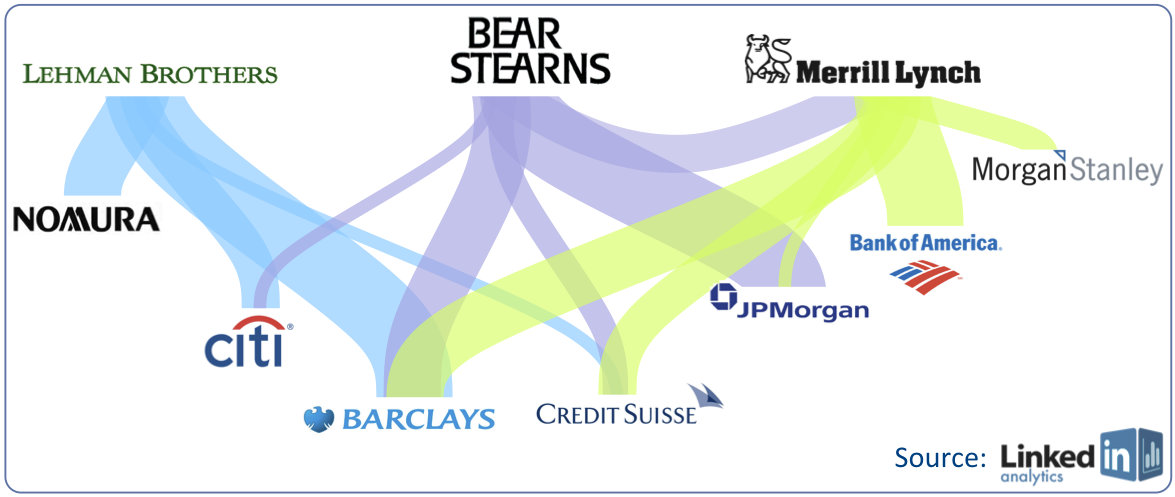
As Data Scientists we are regularly asked about interesting trends taking place on LinkedIn. One of the biggest trends in the professional space last year was the economic collapse. Reports from numerous sources all tell a similar story — the economic downturn has affected thousands of companies with millions of workers laid off.
At LinkedIn we have a unique view into the ebbs and flows of labor markets and one trend we noticed was there were beneficiaries of these large-scale upheavals. In particular, we saw substantial spikes in user activity for the following 5 companies during major financial events:
- Barclays
- Credit Suisse
- Citigroup
- Bank Of America
- JP Morgan Chase
Each of these firms saw an increase in the LinkedIn activity of their employees, measured by member registrations or updates to the individual’s company title on LinkedIn. This activity coincided with key corporate announcements such as the acquisition of Merrill Lynch by Bank Of America, or the Lehman Brothers bankruptcy announcement.
Where did all these employees go? One hypothesis is that many of the employees left the financial industry. According to the LinkedIn data set, that just isn’t true. There are a handful of people that did transition to other industries and start new careers, but most stayed in the financial space. To be specific, other than two acquiring companies (Bank of America acquired Merrill Lynch and Nomura acquired Lehman Brothers’ franchise in the Asia Pacific region), Barclays was by far the biggest beneficiary, scooping up 10% of the laid off talent, followed by Credit Suisse at 1.5% and Citigroup at 1.1 %.
Have you noticed an interesting trend? Do you have a trend or data question you’d like us to answer? Please post them here and we’ll feature them in a future blog post.
- Topics:
- Analytics,
- Infographics


Comments
What an excellent way to demonstrate the depth and breathe of insight available on the LinkedIn Network. This is an ingenious example of how LI data can/will/does support: content strategy for industry researchers and reporters by demonstrating industry trends on industry growth/shrinkage/shifts. In parallel, it also facilitates major corporations a peephole into what is happening at their own companies via self-reported data. LI has truly harnessed a way to understand the intricacies of the global landscape. Economists, research houses and strategist should be paying close attention. I am spreading the word.
Good job guys
Real good analysis, and illustrates how to bring out useful knowledge from raw data.
Excellent analysis – love to see more of this in other spaces and instances (ie Yahoo! would be a good candidate with all the turmoil there – where are those employees going?)
Very Nice!
Here’s a couple of other possible questions:
What’s been happening for Real Estate Agents, Mortgage Brokers, etc during this period?
Or perhaps, info re people broadening or altering their categories of interest and/or expertise to enhance prospects?
Or new licenses or credentials being added to resumes,etc…
Data is interesting stuff!
how many looped back to their original company? (laid off then rehired)
Wow, Barclays holding it down.
So should we interpret this as, whoever got the biggest stream of employees now has the most losers? Heh heh heh.
Interesting analysis! Having left Fidelity then going back inside to spend some time on a contract, I know that there are LinkedIn profiles for folks still showing they are at Fidelity and that is not true. Is that an exception? or are there other profiles incorrectly reflecting a change in status? How much would that throw off this analysis?
Bottom-line, it is a data point. Be careful how you use the data.
What a wonderful way to show the tragic inbreeding that is destroying our financial system.
Great analysis… but it’s hardly surprising that so much “laid-off” talent ended up there…. they acquired Lehman’s North American assets
OK, show your graph pretty much shows a nice representation of the blatantly obvious. Laid off employees from one big company end up at another big company in the same industry. It’s a nice start and basically 1.0 analytics. How about something really significant?
Would love to see the data on recent graduates (class 2008, 2009) going into certain industries (break out sub-categories). Really good analysis and view of where talent is going
I’d love to see a similar analysis looking at Microsoft, Google, AOL, Yahoo! and Facebook.
Everyone’s favorite whipping boy, Goldman is conspicuously absent. No laid-off people welcome there, I guess.
Would be curious if you can determine how many LinkedIn members went from corporate employee to entrepreneur/self employed since the recession began. That would be interesting to know.
Great analysis. Shows lots of interesting possibilities working with specific data sets, people, companies and groups. I think there is a chance for building some high level tools with scripting support here.
It would be also interesting to know where the talent will move after all the laid offs produced in the pharmaceutical industry including the big mergers between Wyeth – Pfizer and Merck – Schering Plough in the last two years.
Great demonstration of the power of the network! I would be curious to see the same analysis of member activity in regards to the executive level members in the construction industry.
Interesting analysis, I had always wondered if LinkedIn paid close attention to employee trends at companies, I guess that they do.
I am sure that there is probably more activity on LinkedIn prior to any major changes at a company, such as a bankruptcy or positive news. As such those who have large stakes in companies likely watch LinkedIn very closely for changes in employee profiles at a company that might indicate a trend.
Of course like Steve Sherlock stated, Linkedin is only a tool, the raw data is not perfect. People may not update their profiles in a timely manner and so any analysis is not perfect.
However the data analysis on the flow of personnel from these financial institutions is very interesting.
Simply awesome analysis. I would be interested in such a graphical representation for different sectors over the recent years.
Is there a way to access this data via the API for our own analyses of company migration? I’d love to do a study project with LinkedIn data.
the difference between a pessimist and an optimist is ‘experience’. The global financial meltdown was man-made, and made in america. All those financial guru’s flocking back to the same opportunities of high risk, no concequence to the trader, and all the risk on the client makes me concerned. A zebra doesn’t change it’s stripes and neither do greedy people…..my course of action will be to stay out of the market. The financial industry operates under the ‘golden rule’….he who has the gold, rules….and they certainly have all the inside power.
Similar to some of the requests above – but instead of requesting a run of the data for a particular industry, can LinkedIn make this analysis feature available to the end-users? Is it planning to do so?
really good job. Maybe a graphical representation for this will be much helpfull. What do you say about a compartian with others as Yahoo, Facebook etc.
All great organizations hire talent and hive off assets when the price is right. Barclays is uniquely place to research world economic trends due to its vintage and it’s reach at the old money regions.
so what. barclays gets a bunch of second stringers -big whoop
I think very useful information available only issue I think needs to be changed again.
Probably there are more activity on LinkedIn prior to any major changes at a company, such as a bankruptcy or positive news as as there is increase in LinkedIn activity of their employees, measured by member registrations or updates to the individual’s company title on LinkedIn
I’m curious about advertising on LinkedIn, what industries are most likely to use it and what is the ROI for advertisers?
This is an interesting trend, but let me suggest an alternative hypothesis that could explain the large proportion of finance personnel staying within the industry. In particular, this observed phenomenon could be simply an artifact of the bias in the LinkedIn user data.
If Bob lost his job in finance and wanted to start in another industry, it’s unlikely that he would use LinkedIn to do so because most of his LinkedIn contacts are probably in finance. On the other hand, Jim, who wanted to stay in finance would likely look precisely to his LinkedIn contacts. It would therefore behoove Jim not only to use LinkedIn, but also to keep their profiles updated. Thus, those who transition out of the finance (or those who are still between-jobs) are probably underreported according to the LinkedIn data, and those who stay within finance are probably overrepresented in the data.
As such, it is still plausible that many left finance after the being laid off. While I do not know the details of the data analysis, readers should be cautious of taking elegant data science to be sensible social science!
This is revealing
Great string…agree with comment that data is skewed. Unfortunately, too many members keep Current Job profile up-to-date, especially “Loss/End of Unemployment” as well as “Industry” updates. Lay-offs are embarrassing enough and pride stops one from announcing on a public profile.
Being awareness of this, it still makes great insight and use of trend data.
Curious, “Age of laid off Workers” would be an interesting study. Over 50′s have been crushed in this economy and may not recover.
Is there a way to access this data via the API for our own analyses of company migration?
good job guys.
Eventually, market expectations become so far removed from reality that people are forced to recognize that a misconception is involved. A twilight period ensues during which doubts grow and more and more people lose faith but the prevailing trend is sustained by inertia.
Hi, I enjoyed viewing your blog site and will be looking forward to your future blog posts. thanks Vincent James – VJ Global
Ha! I was just wondering that! they’re probably out robbing old ladies.
Good question..
Lol!! I love this blog….
I think a lot of people opened their own consulting firms, helping people get loans from the banks they were previously employed.
I found a few of them on a website called The Alternative Loan Machine (ALM). It’s pretty handy to have a people on the inside lol
I really appreciate what you write about here. We try and check it every day so keep up the good articles!
Im sure they are all sitting pretty with bailout money somewhere in the hamptons.
It was rather interesting for me to read the article. Thanx for it. I like such topics and everything that is connected to this matter. I would like to read more on that blog soon.
Bella Benedict
You should write a book. This is compelling information and if you can do it for this set of data, you could do it for a host of other sets. I love freakonomics and this post reminds me of that. Let me know when you become a best seller.
think a lot of people opened their own consulting firms, helping people get loans from the banks they were previously employed.
good job !!!
thank you
Interesting how and where these employees filtered to. Great graph that shows us where exactly to “beware” for the future. LOL.
Interesting Post. Quality content.
Very interesting article. Thank you!
Could you please do some analysis on employee turnover by industry/country/region? I can think of quite a few reasons why this information would be extremely helpful, to mention two: help employees make informed decisions about their careers choices, to give insight to industries about their own unique proposition.