Home > Full Story

January is almost over. But if you didn’t get that promotion, don’t worry –  there’s always April, especially if you’re in India.

One of the questions we’ve heard from you is whether there is an ideal time of the year to ask for a promotion. Does the answer depend on whether you are in Australia or in France? Does it change if you are a teacher or an engineer?

We decided to look for answers in the LinkedIn data. By analyzing over 90 million LinkedIn members’ career histories, we can observe the evolution of labor market trends and discover surprising, interesting or simply fun insights.

New Year, New You vs. Generation “Next!”

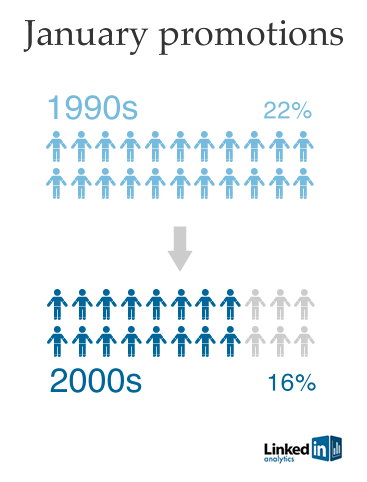
The data confirms that January is indeed the most popular month for promotions. However, we do see a surprising phenomenon: promotions are starting to spread more throughout the year. During the 1990’s, 22% of the promotions occurred in January, but in the most recent decade  that number decreased to 16%.

January promotions

Percentage of promotions occurring in January vs. the rest of the year for the past two decades. January is losing its hold as professionals are promoted more evenly throughout the year.

What is causing this dramatic shift? Are we seeing a more fluid workforce, where you are the brand and need to be proactive in the advancement of your career?

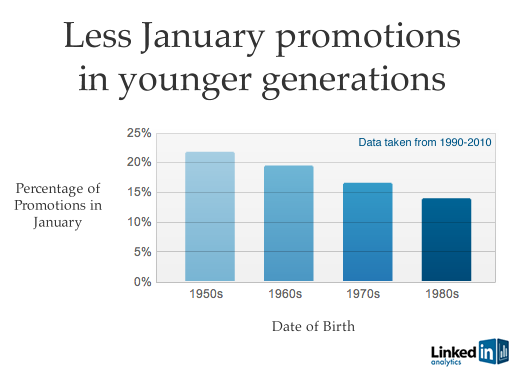
Further analysis reveals that “Millennials” (aka Generation Next) are leading this trend – specifically, professionals born in the 1980s and 1990s. Compared to previous generations (e.g., the Baby Boomers), their promotions are less concentrated in January and instead spread more evenly throughout the year:

Millennials’ promotions spread out more evenly throughout the year. Promotions for Baby Boomers are more concentrated in January.

What is causing this generational shift in the timing of promotions? Perhaps Millennials have “outlandish expectations”of the workplace and are asking for promotions throughout the year.

But there are other possible explanations that we can consider:

  • Do Baby Boomers hold more senior positions that are budgeted on a yearly cycle compared to the more junior positions held by Millennials?
  • Could it be that Millennials are over-represented in industries where fast career progression is the norm? If so, is it a matter of correlation or causation?
  • Are titles spread into more “levels” these days? Has the labor market adapted to a workforce that demands more frequent incentives and feels a constant need to level up?

Do these hypotheses reflect your experience? Do you have others to share? Take our poll on when you prefer to ask for a promotion.

Global Promotion Trends

Does the best time to be promoted vary around the world? Again, we turn to the data of millions of our international members.

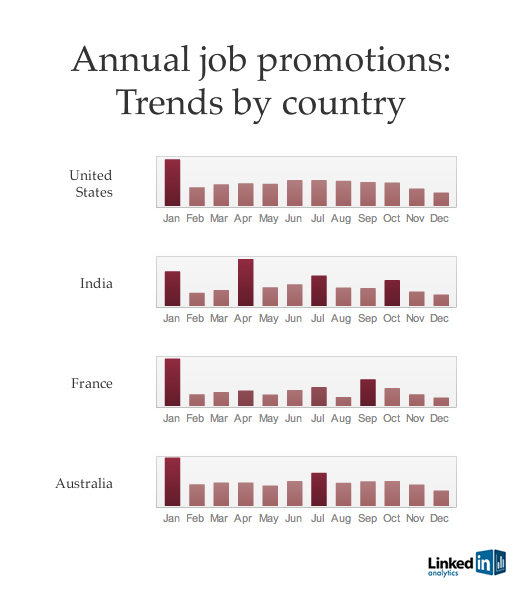
In the US, while January is the top month for promotions, the spread throughout the year is more uniform than the global average. That’s good news for US professionals who have missed the January wave, especially since more than 98% of US companies plan to increase base pay in 2011.

Other countries show their own distinctive character. In France (as in the rest of southern Europe), the promotion data reflects the traditional August vacation and the corresponding September surge. In Australia, we see a peak in July — the beginning of their fiscal year. In India, the fiscal year begins in April, leading to the unique result that April trumps January as the most popular month for promotions there.

Promotions around the globe: Percentage of promotions occurring each month, based on millions of career histories for the past 20 years.


Your Industry: Four Seasons or Summer Camp?

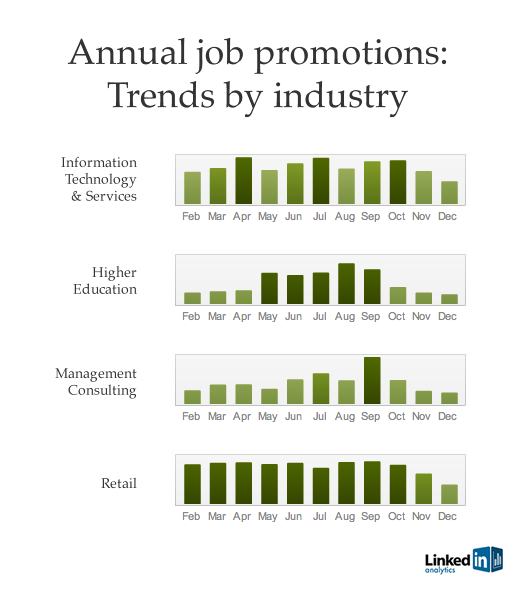
We’ve seen how promotions vary throughout the world – but are there differences across industries? Indeed there are — in the form of distinct seasonal trends. We’ve removed the peak month of January from these last graphs to highlight the differences among industries.

Variations in industry seasonal patterns (January omitted). Data includes millions of career histories for the past 20 years.

Information Technology companies follow a typical quarterly pattern, with promotions concentrated at the beginning of each quarter.  However, in the Higher Education industry promotions coincide with the summer vacation months. Management Consulting complements the January spike with a second spike in September. Finally, Retail spreads promotions almost uniformly throughout the year following the January spike.

So what’s the take-home message? The patterns in the data are striking, and we’ve offered some of our own hypotheses. But we’d really like to hear what you think is going on. Please share your insights in the comments section and take our poll on when you prefer to ask for a promotion.

When would you prefer to ask for a promotion?

Trackback: http://blog.linkedin.com/2011/01/26/linkedin-promotions-data/trackback/
Add New Comment

Comments

  • Bryan D January 26th, 2011

    Very interesting analysis. I’m curious how you measured promotions in your data? Was it some formula that looked for a change in job title where the company name didn’t change? If so, wouldn’t that include lateral moves and not just promotions?

    I’m not sure how much that might skew the analysis (if at all), I’m just curious.

    Regardless, this kind of data mining/analysis is outstanding — keep up the good work. Thanks!

     
  • Ronald Gruia January 26th, 2011

    Monica – impressive study. Just wondering about your methodology: did you conduct interviews or just relied on promotion data from LinkedIn itself? Because sometimes there could be a lag time in between a person receiving a promotion and updating their status on LinkedIn (actually that could be a survey topic itself ;-) .

    Cheers -

    RG

     
  • abhasin January 26th, 2011

    INsighful!!

     
  • Ed Dodds January 26th, 2011

    Monica:

    You are an excellent example of why kids should study STEM and…

    RT @whitehouse: “it’s not just the winner of the Super Bowl who deserves to be celebrated, but the winner of the science fair” #SOTU

     
  • David T. Stevens January 26th, 2011

    The thing about “millenials”, “gen y”, or “Generation Next” is that they are a move up or move on generation. The average timefrane they stay at a job is 2-4 years. They have an unmatched sense of loyalty.* That loyalty comes at a cost. They want to be recognized and feel like they are continually moving forward. Most people I know would be ok with the same amount of money as long as they get a title upgrade for their efforts. Or if the title isn’t going to change…”show me the money” otherwise I’m out.

     
  • Monica Rogati January 26th, 2011

    Appreciate your comments and questions – interesting discussion!

    @Bryan – promotions were indeed defined as title changes within the same company. Yes, this includes lateral moves, but such cases are relative rare and we have no reason to believe lateral moves skew the seasonality towards a certain month/season vs. the others.

    @Ronald – One interesting point is that our analysis doesn’t necessarily rely on people updating their profile in real time. You could be creating your profile in 2009 and telling us about a 2003 promotion by adding the consecutive roles to your profile. It’s true, however, that the last few months of 2010 could be under-represented as a percentage due to people not adding their December 2010 promotion yet – but the fact that our stats are taken over 20 years mitigates this.

    @Ronald again – this was based on LinkedIn profile data – 90+ millions of global datapoints. A survey to gather the same data would be very expensive and time-consuming – which is why it’s so exciting to see the power of LinkedIn data in action.

     
  • Matt February 2nd, 2011

    This is nothing more than work for works sake. Data collection and presentation without mission. You people are idiots, and because I’m not, I don’t care when the majority of the planet gets promoted. Moreover, why should you?
    Defend the point of this survey.

     
  • Matt February 2nd, 2011

    Sorry, one more point to David. Love the fact that you can quote World@work verbatum – how do you differentiate between the year you were born versus the life stage you exist in. For clarification, married, divorced, single, owner, renter. If nothing else, we evolve to blur these distinctions with age, rather than the constant and easily identifiable date of birth.
    I would quickly move away from tagging based on age and move toward the slighly more complex task of identifying the needs of your demographic.

     
  • Ed Dodds February 3rd, 2011

    Any plans to adopt hr-xml resume standards or include them in APIs? Plans to tie them to any federal taxonomies (US resumes)? Thanks.

     
  • jonah -anuncios el mundo October 26th, 2011

    know if at the end of this year there is a new promotion I would like to participate but I have seen time and closed the greeting


Add New Comment

This is a moderated site and comments will appear if and when they are approved. We will review the queue several times daily, so please don't resubmit if your comment doesn't appear immediately.